

Why Mental Toughness Separates Good Athletes From Great Ones
In competitive sports, physical talent may get athletes noticed—but mental toughness is what helps them perform under the highest pressure.
Two athletes can have the same speed, strength, and skill level, yet perform very differently in crucial moments. One becomes overwhelmed by stress and self-doubt. The other stays focused, confident, and composed.
The difference isn’t talent alone. It’s mental training.
Mental toughness is the ability to maintain focus, confidence, and emotional control under pressure, fatigue, and adversity. It helps athletes perform consistently, recover from setbacks, and stay resilient when challenges arise.
From basketball and tennis to soccer and squash, elite athletes share one common trait: a strong mindset. Athletes like Kobe Bryant and Serena Williams demonstrated exceptional mental resilience, discipline, and the ability to perform under pressure when it mattered most.
The good news is that mental toughness is not something you’re born with. Like physical fitness, it can be developed through practice, mindset training, and proven sports psychology techniques.
In this guide, you’ll learn how to build mental toughness, strengthen your athlete mindset, improve performance under pressure, and develop the mental skills needed for long-term success in sports.
This article is written by Dora Kurimay, MA, CMPC, Certified Mental Performance Consultant and sports psychology coach.
Key Takeaways
- Mental toughness is a skill that can be developed through consistent practice and mental training.
- Athletes build mental toughness by learning to manage pressure, overcome setbacks, and stay focused during competition.
- Confidence grows from preparation, repetition, and evidence—not motivation alone.
- Emotional control and resilience help athletes perform consistently under stress.
- Mental skills such as self-talk, visualization, mindfulness, and focus training can improve athletic performance.
Table of Contents
-
What Is Mental Toughness in Sports?
-
Why Mental Toughness Matters in Athletic Performance
-
How to Build Mental Toughness
-
Confidence and Resilience
-
Emotional Control Under Pressure
-
Recovering From Mistakes and Setbacks
-
Final Thoughts
- Frequently Asked Questions
What Is Mental Toughness in Sports?
Mental toughness is not about being emotionless or fearless. It’s about performance stability under pressure.
A mentally tough athlete can:
- Perform under stress
- Recover quickly from mistakes
- Stay focused during distractions
- Maintain confidence after failure
- Push through discomfort and fatigue
- Execute skills when it matters most
It is the combination of emotional control, focus, resilience, and confidence.
Importantly, mental toughness is not about never breaking down—it’s about how fast you rebuild when you do.
Read more about what mental toughness is.
Why Mental Toughness Matters in Athletic Performance
At elite levels, physical differences are often minimal. What separates winners from everyone else is how they respond to:
- High-pressure moments
- Momentum shifts
- Fatigue in late-game situations
- Mistakes and setbacks
- External pressure (crowd, coaches, expectations)
Athletes with strong mental toughness:
- Make better decisions under fatigue
- Recover faster from errors
- Maintain execution in clutch moments
- Avoid emotional spirals
- Perform more consistently across a season
Without it, even highly skilled athletes become inconsistent.
1. Redefine What Mental Toughness Actually Means

One of the biggest misconceptions in sports is that mental toughness means “never feeling pressure.”
That’s not realistic.
Even elite professionals feel:
- Anxiety before competition
- Frustration after mistakes
- Doubt in critical moments
The difference is not the absence of these emotions—it’s the ability to act effectively despite them.
A better definition:
Mental toughness is the ability to stay functional under psychological and physical pressure.
When you stop trying to eliminate emotions, you start learning how to perform alongside them.
2. Build Reset Routines Between Plays
One of the most important mental skills in sports is the ability to reset quickly after mistakes.
Without a reset system, athletes tend to:
- Replay errors in their head
- Lose focus on the next play
- Spiral emotionally
- Make repeated mistakes
What a reset routine looks like
A reset routine is a short, repeatable sequence that brings attention back to the present moment.
Examples:
- Deep breath (inhale 4 seconds, exhale 6 seconds)
- Physical cue (tap helmet, adjust shoes, bounce ball)
- Verbal cue (“next play,” “reset,” “lock in”): Cue words
- Eye focus shift (look at the field/court target)
The goal is to interrupt emotional momentum and re-anchor attention.
The best athletes don’t dwell—they reset.
3. Train Under Pressure (Not Just Under Comfort)
Most training environments are too controlled. Athletes practice skills, but not stress.
Then they wonder why they struggle in games.
To build mental toughness, training must include exposure to pressure.
Ways to simulate pressure:
- Time constraints (make decisions faster than normal)
- Consequence drills (miss = sprint, penalty, etc.)
- Fatigue-based training (skills under exhaustion)
- Crowd noise simulation or distractions
- Scrimmages with scoring pressure
The goal is to make stress feel familiar.
When pressure becomes normal, it loses power.
4. Master Your Internal Dialogue

The conversation inside an athlete’s head often determines performance more than physical ability.
Under stress, untrained minds default to:
- “Don’t mess up.”
- “I can’t fail here.”
- “What if I lose this?”
These thoughts increase tension and reduce performance.
Mentally tough athletes replace them with task-based cues:
- “Next play.”
- “See it early.”
- “Breathe and execute.”
- “Simple decisions.”
This shift reduces emotional noise and increases clarity.
The goal is not positivity—it’s usefulness.
Read more about how to master your self-talk.
5. Learn to Perform While Uncomfortable
Discomfort is part of competition:
- Burning muscles in endurance sports
- Nervous energy before big games
- Pressure in the final minutes
- Fear of making mistakes
Many athletes try to eliminate discomfort. Mentally tough athletes accept it and continue performing.
A powerful mental question:
“Can I still execute while feeling this?”
Over time, the answer becomes yes more often.
This is where resilience is built—not in comfort, but in controlled discomfort.
Mental toughness and resilience go hand in hand. If you’d like to learn more about bouncing back from setbacks, read our guide on resilience in sports: resilience guide in sports.
6. Separate Identity From Performance
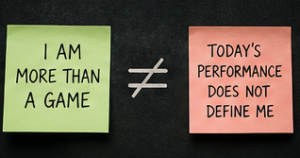
One of the biggest mental performance killers is identity fusion:
- “If I play badly, I am bad.”
This creates fear-based performance:
- Overthinking
- Hesitation
- Avoidance of risk
- Emotional instability
Strong athletes separate identity from outcomes:
- Performance is temporary
- Identity is stable
A missed shot or bad game does not define ability—it provides feedback.
This mindset reduces emotional volatility and increases consistency.
7. Build Confidence Through Evidence, Not Emotion
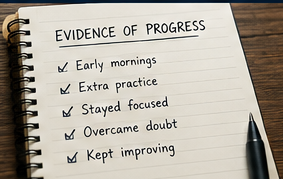
Confidence is often misunderstood as something you “feel.”
But in reality, confidence is built through evidence:
- Repeated training success
- Past clutch performances
- Consistent preparation
- Small wins in practice
When doubt appears, confident athletes don’t argue emotionally—they reference evidence.
Example internal shift:
- Doubt: “I’m not ready.”
- Response: “I’ve done this before. I’ve prepared for this.”
Confidence is memory-based, not mood-based.
“Confidence is built through preparation, not wishful thinking.”
8. Control the Controllables
Mental toughness grows when attention is directed only at what you can influence.
Unproductive focus:
- Referee decisions
- Opponent behavior
- Crowd reactions
- Past mistakes
- Future outcomes
Productive focus:
- Effort level
- Positioning
- Technique
- Communication
- Decision-making
- Preparation
Elite performers simplify focus under stress. Complexity creates hesitation. Read more about how to control the controllable.
9. Build Faster Recovery After Failure
Every athlete fails. The difference is in recovery speed.
Mentally tough athletes:
- Acknowledge mistakes briefly
- Extract one lesson
- Reset immediately
Mentally weak patterns:
- Overthinking errors
- Emotional collapse
- Carrying mistakes into future plays
A useful rule:
“Review it later. Not during performance.”
The faster you reset, the less one mistake affects the next ten plays.
10. Practice Emotional Regulation Daily
Mental toughness is not only built during games—it’s built in daily habits.
You can train emotional control through:
- Controlled breathing exercises
- Visualization of pressure scenarios
- Mindfulness training: Benefits of Mindfulness
- Journaling reactions after training
- Reflection without self-criticism: Everything starts with self-reflection
These practices strengthen awareness and emotional stability over time.
11. Build a Pre-Performance Routine
A consistent pre-game routine reduces uncertainty and stabilizes focus.
A strong routine may include:
- Warm-up sequence
- Visualization of key plays: The Power of Visualization
- Breathing exercises
- Music or silence preference
- Mental cue words
The goal is to create familiarity before chaos begins.
12. Recovery Is Part of Mental Toughness
Mental toughness is not just about pushing harder—it’s also about recovering smarter.
Without recovery, mental fatigue builds:
- Slower reaction times
- Poor decision-making
- Emotional instability
Recovery tools:
- Sleep consistency
- Post-game decompression
- Light physical activity
- Mental shutdown routines (no analysis immediately after games)
Recovery protects performance longevity.
Final Thoughts: Mental Toughness Is Built, Not Found
Mental toughness is not something athletes are born with—it is a skill that can be developed through consistent practice, exposure to challenges, and intentional mental training.
The most successful athletes aren’t the ones who never experience fear, doubt, or setbacks. They’re the ones who learn how to respond effectively when those challenges arise. They:
- Reset quickly after mistakes
- Stay focused under pressure
- Perform through discomfort
- Learn from setbacks without losing confidence
- Remain consistent when others become overwhelmed
Like strength, speed, and endurance, mental toughness requires training. The more you practice resilience, emotional control, confidence, and focus, the stronger your mental game becomes.
Remember, pressure is not the enemy. Pressure is an opportunity to apply the mental skills you’ve developed through preparation and experience. Every challenge, setback, and high-stakes moment is a chance to strengthen the mindset that separates good athletes from great ones.
If you train your mind with the same commitment you bring to your physical training, you’ll not only improve your athletic performance—you’ll develop skills that benefit you in school, work, relationships, and life beyond sports.
Ready to Strengthen Your Mental Game?
Whether you’re a high school athlete striving to perform with more confidence, a college competitor navigating the demands of elite sports, or a parent looking to support your athlete’s development, mental toughness can be learned and strengthened.
Working with a sports psychology professional can help athletes develop the mental skills needed to manage pressure, overcome setbacks, build confidence, improve focus, and perform at their best when it matters most.
If you’re ready to develop a stronger mindset and unlock your full potential, Dora Kurimay can help. Through evidence-based sports psychology and mental performance coaching, athletes learn practical strategies to build confidence, resilience, emotional control, and lasting competitive success.
Take the next step toward becoming a more confident, resilient, and mentally strong athlete. Contact Dora today to learn how mental performance coaching can help you achieve your goals.
Book a complimentary Mental Performance Strategy Call and discover:
- What’s holding you back mentally
- How to perform under pressure
- A personalized mental training roadmap
Book Your Complimentary Strategy Call
Frequently Asked Questions
What is mental toughness in sports?
Mental toughness is the ability to stay focused, confident, and composed under pressure. It helps athletes manage stress, overcome setbacks, and perform consistently in challenging situations.
Can mental toughness be developed?
Yes. Mental toughness is a skill that can be strengthened through deliberate practice, mindset training, emotional regulation, and sports psychology techniques.
How do athletes build confidence under pressure?
Athletes build confidence through preparation, repetition, positive self-talk, visualization, breathing, and learning to focus on controllable factors rather than outcomes.
Why is mental toughness important for athletes?
Mental toughness helps athletes maintain focus, recover from mistakes, manage performance anxiety, and perform at their best during competition.
What are the key components of mental toughness?
Mental toughness includes resilience, confidence, emotional control, focus, adaptability, and the ability to perform effectively under pressure.
About Dora Kurimay
 Dora Kurimay, MA, CMPC, is a Certified Mental Performance Consultant specializing in sport psychology and mental performance coaching. She helps athletes strengthen their mindset, build confidence, manage pressure, and perform at their best. Through evidence-based strategies, Dora supports athletes, coaches, and parents in developing the mental skills that drive long-term success both on and off the field.